Rail National Crossroads: The Freight Hub of Australia
Positioned at the critical junction connecting Sydney-to-Perth and Melbourne-to-Brisbane rail corridors.
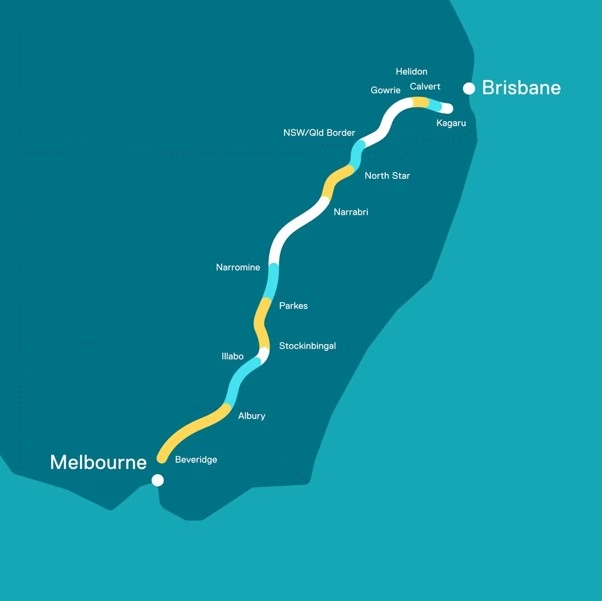
Inland Rail Route (Melbourne to Brisbane)
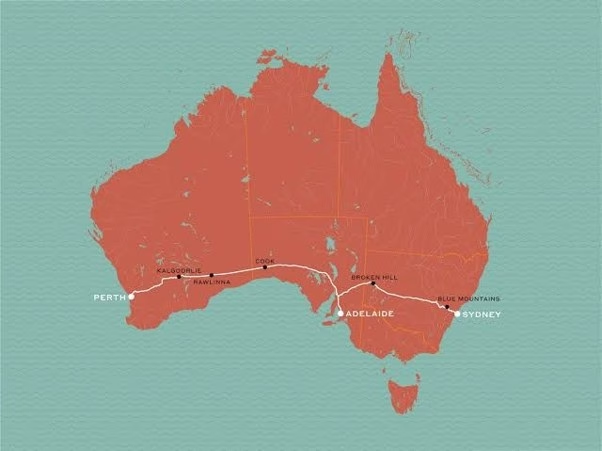
Indian Pacific Line (Sydney to Perth)
Australia’s Population Reached Within 12 Hours

$10B Inland Rail Project
A 1,600 km direct rail line linking Melbourne and Brisbane, bypassing Sydney’s congested network.

Indian Pacific Rail
The iconic 4,352 km line connecting Sydney to Perth.

National Supply Chain
Rail freight is vital to commodities export and projected to grow 5.7% by 2050.
Rail Freight
Rail freight is essential to Australia’s commodities export. It is dominated by iron ore and coal, which represent over 75 per cent of Australia’s total rail freight volume by weight. The Australian freight task has grown more than four-fold over the five decades to 2020, from around 127 billion tonne kilometres in 1970–71 to nearly 800 billion tonne kilometres in 2019–20. The average rate of growth is of over 3.6 per cent per annum. Over that period road freight has increased eight-fold, from around 26 billion tonne kilometres in 1970–71 to around 223 billion tonne kilometres in 2019–20. Rail freight has increased more than ten-fold, from around 40 billion tonne kilometres in 1970–71 to nearly 450 billion tonne kilometres in 2019–20, propelled by the significant recent growth in iron ore and coal exports.
Air freight, which is several orders of magnitude smaller than other modes, has grown from around 90 million tonne kilometres in 1970–71 to around 295 million tonne kilometres in 2019–20. The forecasts predict total domestic freight volumes are projected to grow by approximately 26 per cent between 2020 and 2050. Road freight volumes are projected to grow by around 77 per cent between 2020 and 2050. Rail freight volumes are projected to grow by around 5.7 per cent between 2020 and 2050. Air freight volumes are projected to grow by around 103 per cent between 2020 and 2050 from 290 million tonne kilometres in 2020 to around 589 million tonne kilometres in 2050.
Indian Pacific Rail
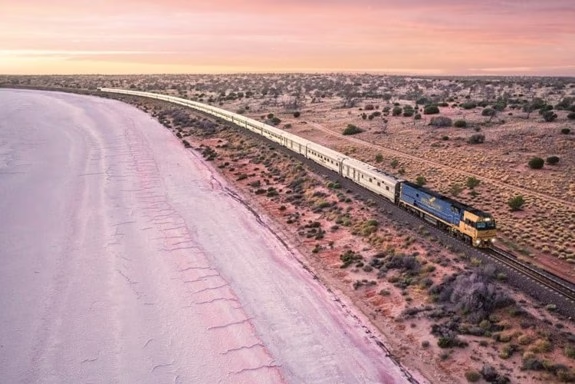
The Indian Pacific travels through Parkes with the Parkes Station around 20kms from Alectown. The Sydney to Perth rail corridor runs for 4352 kilometres (2704 mi) across Australia from Sydney, New South Wales, to Perth, Western Australia. Most of the route is under the control of the Australian Rail Track Corporation. The corridor is heavily trafficked by long-distance freight trains. The rail corridor carries more than 81% of land freight between the eastern states and Perth.
The Indian Pacific is a weekly tourism-oriented passenger train service that runs between Sydney, and Perth. Like its counterpart; The Ghan, the Indian Pacific is one of few transcontinental trains operating anywhere in the world and is rated as one of the great rail journeys of the world. Its route includes the world’s longest straight stretch of railway track, a 478-kilometre (297 mi) stretch of the Trans-Australian Railway across the Nullarbor Plain. Tourists can board the Indian Pacific from Parkes to make the journey to Perth.
Inland Rail
Inland Rail is a 1,600km freight rail line now under construction in Australia. This map provides an overview of the Inland Rail project alignment between Melbourne and Brisbane, via regional Victoria, NSW and Queensland. The Inland Rail will provide an enhanced link between Queensland and Southern Australia to enable freight travelling to Brisbane to bypass the busy Sydney Network.
The Inland Rail is being delivered by the Australian Government to support the projected national growth in freight over the next several decades. The Inland Rail will provide an enhanced link between Queensland and Southern Australia, including Adelaide and Perth (via Parkes), and enable freight travelling from Brisbane to Melbourne to bypass the busy Sydney network.
The planned route is about 1,700 kilometres between Melbourne and Brisbane of which 1,047 kilometres is in NSW. It requires 475 kilometres of upgrades to existing tracks and 399 kilometres of new tracks in NSW.